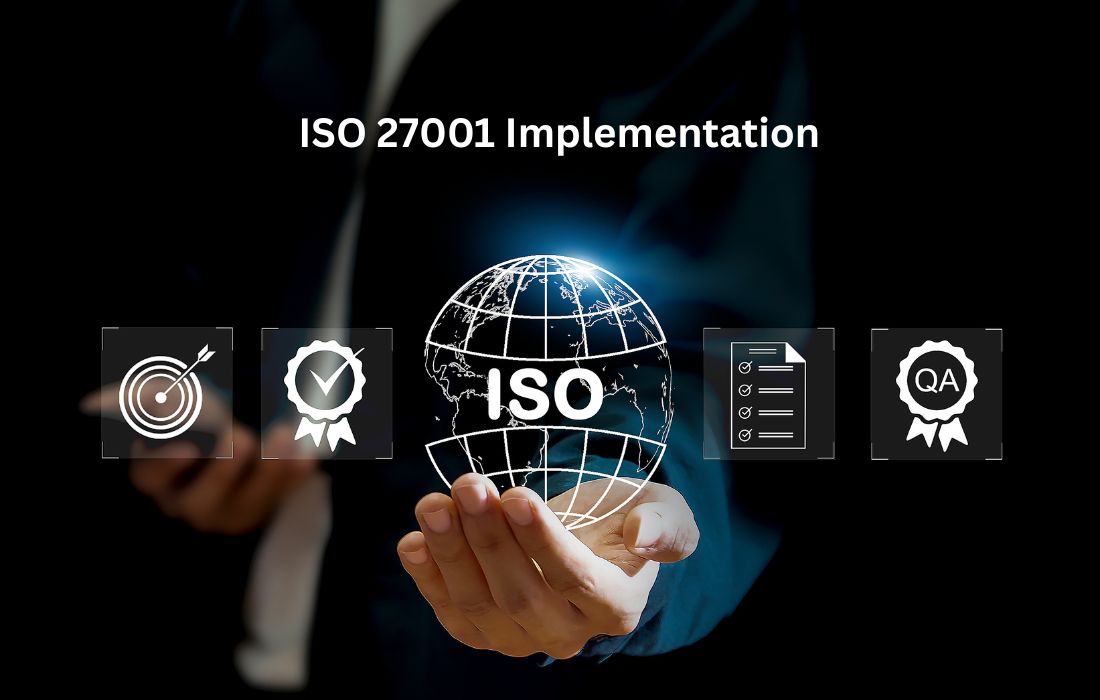
ISO 27001 implementation is the process of establishing, operating, maintaining, and continually improving an Information Security Management System (ISMS) based on ISO/IEC 27001 requirements.
For most organizations, implementation involves defining the ISMS scope, understanding business and security risks, conducting a gap assessment, developing policies and procedures, implementing appropriate controls, training employees, monitoring the ISMS, conducting an internal audit, and completing management review.
ISO/IEC 27001:2022 is the current edition of the standard. It provides requirements for organizations to establish, implement, maintain, and continually improve an ISMS and can be applied to organizations of different sizes and sectors.
The implementation process is different for every organization. A small company with a focused scope and mature security practices may move faster, while a large enterprise with multiple locations, systems, departments, and suppliers may require significantly more time.
What Is ISO 27001 Implementation?
ISO 27001 implementation means putting an effective Information Security Management System (ISMS) into practice within a defined organizational scope.
An ISMS is more than a collection of cybersecurity policies or technical controls. It connects information-security risks with business processes, people, technology, policies, controls, monitoring, audits, management oversight, and continual improvement.
The purpose of implementation is to create a structured and repeatable approach to:
- Identify information-security risks
- Evaluate and prioritize those risks
- Determine appropriate risk-treatment measures
- Establish information-security policies and processes
- Implement applicable controls
- Assign responsibilities
- Monitor security performance
- Conduct internal audits
- Review the ISMS at management level
- Continually improve information-security practices
ISO describes ISO/IEC 27001 as a standard that enables organizations to establish an ISMS and apply a risk-management process appropriate to their size, needs, and circumstances.
ISO 27001 Implementation Process at a Glance
A practical ISO 27001 implementation roadmap typically includes these steps:
| Step | What happens |
|---|
| 1. Management commitment | Establish objectives, ownership, and resources |
| 2. Define ISMS scope | Determine what people, processes, systems, locations, and information are covered |
| 3. Understand business context | Identify relevant internal and external factors |
| 4. Conduct gap assessment | Identify gaps between current practices and applicable requirements |
| 5. Perform risk assessment | Identify, analyze, and evaluate information-security risks |
| 6. Develop risk treatment plan | Determine how identified risks will be addressed |
| 7. Develop ISMS documentation | Establish relevant policies, procedures, and records |
| 8. Implement controls | Put appropriate security measures into operation |
| 9. Train employees | Build security awareness and role-specific competence |
| 10. Monitor the ISMS | Measure performance and control effectiveness |
| 11. Conduct internal audit | Evaluate ISMS conformity and effectiveness |
| 12. Management review | Review ISMS performance and improvement needs |
| 13. Prepare for certification | Complete readiness activities before the external audit |
Implementation does not end when documentation is completed. The organization needs to operate the ISMS and generate evidence that relevant processes are functioning effectively.
1. Obtain Management Commitment
ISO 27001 implementation should begin with leadership commitment.
Senior management needs to understand why the organization is implementing an ISMS, what business objectives it supports, what resources are required, and who owns the implementation.
Management commitment helps establish:
- Information-security objectives
- Roles and responsibilities
- Project ownership
- Required resources
- Implementation priorities
- Reporting structures
- Management oversight
ISO 27001 should not become an isolated IT project. Information security affects employees, operations, suppliers, management, technology, and business processes, so implementation should involve the appropriate functions across the organization.
2. Define the ISMS Scope
The next step is defining the scope of the ISMS.
The scope determines which parts of the organization are included in implementation and, where certification is pursued, which parts are included within the certification scope.
The scope may include:
- Products or services
- Business units
- Offices and locations
- Cloud environments
- Information systems
- Employees and contractors
- Business processes
- Supporting functions
- Third-party services
A clearly defined scope helps keep implementation focused.
For example, a SaaS company may define its ISMS around a particular SaaS platform, supporting cloud infrastructure, relevant employees, and associated business processes.
A large enterprise may need to consider multiple locations, departments, systems, and business functions.
Organizations planning certification can review Prowise Systems’ ISO 27001 certification services for support with scope definition, implementation, risk assessment, internal audits, and certification readiness.
3. Understand the Organization’s Context
ISO 27001 implementation should reflect how the organization actually operates.
The organization should consider internal and external factors that can affect the ISMS, including:
- Business objectives
- Organizational structure
- Technology environment
- Legal and regulatory obligations
- Customer requirements
- Supplier relationships
- Information-security risks
- Business continuity needs
- Geographic operations
- Interested-party expectations
This prevents organizations from implementing a generic security program that does not address their actual business risks.
For example, the information-security priorities of a healthcare organization may differ from those of a SaaS company, financial-services business, manufacturer, or government contractor.
4. Conduct an ISO 27001 Gap Assessment
A gap assessment compares the organization’s existing information-security practices with the applicable ISO 27001 requirements.
The objective is to understand:
- What already exists
- What is partially implemented
- What needs improvement
- What is missing
- What evidence is available
- What needs to be implemented before certification
A gap assessment may identify weaknesses in:
- Information-security policies
- Risk management
- Access control
- Asset management
- Incident management
- Supplier management
- Business continuity
- Employee awareness
- Monitoring and measurement
- Internal audit
- Management review
- Documented information
The result should be a practical implementation plan that prioritizes the most important work.
For a broader explanation of the standard, see Prowise Systems’ ISO 27001 certification requirements guide.
5. Perform an ISO 27001 Risk Assessment
Risk assessment is one of the most important parts of ISO 27001 implementation.
The organization needs a defined method for identifying and evaluating information-security risks.
Depending on the organization’s methodology, the assessment may consider:
- Information assets
- Threats
- Vulnerabilities
- Potential consequences
- Likelihood
- Existing controls
- Risk levels
- Risk acceptance criteria
The purpose is to understand which information-security risks require treatment and which measures are appropriate.
ISO/IEC 27001 does not require every organization to use one identical risk-assessment methodology. The approach should be suitable for the organization’s context and produce consistent, meaningful results.
6. Develop a Risk Treatment Plan
After assessing risks, the organization determines how those risks will be treated.
Risk treatment may involve:
- Reducing risk through controls
- Avoiding a risk
- Sharing or transferring certain risks
- Accepting risk within defined criteria
Each relevant treatment decision should have appropriate ownership and supporting evidence.
This step connects risk assessment with practical security improvements.
It also prevents ISO 27001 implementation from becoming a simple checklist exercise. Controls should be selected based on the organization’s risks, requirements, and circumstances.
7. Develop ISMS Policies and Procedures
The organization then develops or updates the policies, procedures, and documented information needed to operate the ISMS.
Depending on the organization’s scope and risks, documentation may address:
- Information-security policy
- Access control
- Asset management
- Acceptable use
- Authentication
- Data classification
- Incident management
- Supplier security
- Backup and recovery
- Business continuity
- Security awareness
- Change management
- Risk management
- Internal audit
- Corrective action
Documentation should reflect actual business practices.
Creating policies that employees do not follow can create implementation problems and increase the risk of audit findings.
The objective is to create practical processes that employees understand and consistently follow.
8. Implement Appropriate Security Controls
Security controls are the practical measures used to address information-security risks.
Depending on the organization’s risk assessment, controls may address:
- Identity and access management
- Multi-factor authentication
- Security awareness
- Asset management
- Logging and monitoring
- Incident response
- Backup and recovery
- Supplier security
- Physical security
- Endpoint protection
- Network security
- Data protection
- Secure development
ISO/IEC 27001:2022 uses Annex A as a reference set of information-security controls. Organizations should determine applicable controls through their risk-treatment process rather than treating Annex A as a simple checklist that every organization must implement in exactly the same way.
The important objective is to ensure that appropriate controls are selected, implemented, monitored, and supported by evidence.
9. Train Employees and Build Security Awareness
Employees are an important part of the ISMS.
Training and awareness should help employees understand:
- Their information-security responsibilities
- Relevant organizational policies
- Secure handling of information
- Access-control responsibilities
- Incident-reporting procedures
- Phishing and social-engineering risks
- Data-protection expectations
- Consequences of security incidents
Training should be appropriate to each employee’s role.
For example, developers may require secure-development awareness, while finance employees may need greater emphasis on financial information, fraud risks, and access controls.
The organization should maintain appropriate evidence of training and awareness activities.
10. Monitor and Improve the ISMS
ISO 27001 implementation does not end when controls are deployed.
The organization needs processes for monitoring and evaluating ISMS performance.
This may include monitoring:
- Information-security incidents
- Risk-treatment progress
- Security objectives
- Audit findings
- Corrective actions
- Employee training
- Control performance
- Supplier-security issues
- Security events
- Performance indicators
Monitoring helps management determine whether the ISMS is achieving its objectives.
Continual improvement is an important part of the management-system approach. ISO/IEC 27001 is designed for establishing, maintaining, and continually improving an ISMS rather than implementing it once and leaving it unchanged.
11. Conduct an Internal Audit
Before pursuing certification, the organization should evaluate its ISMS through internal audit activities.
The internal audit helps determine whether the ISMS:
- Conforms to applicable requirements
- Follows the organization’s own processes
- Is operating effectively
- Has appropriate evidence
- Requires corrective action
An internal audit may identify:
- Nonconformities
- Missing evidence
- Inconsistent procedures
- Control weaknesses
- Documentation gaps
- Process improvements
Addressing significant findings before the external certification audit can improve audit readiness.
12. Complete Management Review
Management review provides formal leadership oversight of the ISMS.
Management should review relevant information about:
- ISMS performance
- Internal audit results
- Security objectives
- Risk status
- Corrective actions
- Changes affecting the organization
- Opportunities for improvement
This demonstrates that information security is being managed at an organizational level rather than treated only as an IT responsibility.
Management review also provides an opportunity to make decisions about resources, priorities, and improvements.
13. Prepare for ISO 27001 Certification
ISO 27001 implementation and ISO 27001 certification are not the same thing.
Implementation means establishing and operating the ISMS.
Certification is an independent conformity-assessment process conducted by a certification body.
Organizations pursuing certification normally prepare for a two-stage certification audit.
Stage 1 Audit
The certification body evaluates the organization’s readiness and develops an understanding of the ISMS, its scope, processes, locations, and relevant documented information.
Stage 2 Audit
The certification body evaluates whether the ISMS has been implemented and is operating effectively against the applicable requirements.
If nonconformities are identified, the organization may need to complete corrective actions before certification can be granted.
How Long Does ISO 27001 Implementation Take?
There is no single ISO 27001 implementation timeline that applies to every organization.
For planning purposes, implementation commonly takes several months, but the actual duration depends on:
- Organization size
- ISMS scope
- Existing security maturity
- Number of locations
- IT complexity
- Number of employees
- Third-party relationships
- Existing policies and controls
- Internal resources
- Certification objectives
A small organization with a focused scope and mature security practices may move faster.
A large enterprise with multiple locations, complex infrastructure, numerous suppliers, and multiple business units may require significantly more time.
For the separate question of how long ISO 27001 certification takes, see Prowise Systems’ ISO 27001 certification timeline guide.
ISO 27001 Implementation for Small Businesses
ISO/IEC 27001 can be applied to organizations of different sizes and sectors. ISO also provides a practical guide specifically for SMEs implementing an ISMS.
Small businesses may benefit from:
- Smaller ISMS scope
- Fewer employees
- Fewer locations
- Simpler organizational structures
- Faster decision-making
However, limited internal resources can also create challenges.
A small business does not need to copy an enterprise security program. The ISMS should be appropriate to its business objectives, risks, resources, and scope.
ISO 27001 Implementation for SaaS and Technology Companies
SaaS and technology organizations often need to demonstrate strong information-security practices to enterprise customers and business partners.
Implementation may address:
- Cloud infrastructure
- Identity and access management
- Secure software development
- Change management
- Vulnerability management
- Logging and monitoring
- Data protection
- Supplier management
- Incident response
- Business continuity
- Customer-data security
The ISMS scope should clearly identify the services, systems, people, and processes included in the implementation.
Prowise Systems supports technology and other organizations through ISO 27001 certification and implementation services.
Common ISO 27001 Implementation Challenges
Organizations commonly experience challenges when implementation is treated as a documentation project rather than a management-system initiative.
Unclear Scope
An unclear scope can make risk assessment, control implementation, evidence collection, and auditing more difficult.
Limited Management Involvement
Without leadership support, information-security responsibilities may remain concentrated within IT.
Incomplete Risk Assessment
Implementing controls without properly evaluating risks can result in unnecessary work and missed priorities.
Policies That Do Not Match Reality
Documentation should describe processes that the organization actually follows.
Insufficient Evidence
Organizations need evidence that relevant processes and controls are operating.
Limited Internal Resources
Implementation often requires input from management, IT/security, HR, legal, procurement, operations, and other business functions.
How to Make ISO 27001 Implementation More Efficient
Organizations can make implementation more predictable by following a structured approach.
Define the scope early. Avoid implementing processes across systems and operations outside the intended scope.
Start with a gap assessment. Understand what already exists before creating new policies and controls.
Use a risk-based approach. Prioritize information-security risks rather than implementing controls simply because they appear on a checklist.
Assign clear ownership. Give each major implementation activity an accountable owner.
Reuse existing processes. Existing security, privacy, business-continuity, or compliance processes may provide a useful foundation where they support the ISMS.
Collect evidence as you go. Do not wait until the certification audit to gather evidence.
Test the ISMS before certification. Internal audit and management review provide opportunities to identify and correct issues.
ISO 27001 Implementation Services
Organizations can implement ISO 27001 internally, use external consultants, or combine internal teams with consulting support.
External implementation support can help with:
- Gap assessment
- ISMS scope
- Risk assessment
- Risk treatment
- Policy development
- Control implementation
- Employee awareness
- Internal audit
- Corrective actions
- Certification readiness
Prowise Systems provides ISO 27001 consulting services to help organizations develop practical, risk-based ISMS programs.
Support can include:
- ISO 27001 gap analysis
- ISMS implementation
- Risk assessment
- Documentation and policy development
- Control implementation support
- Employee training
- Internal audit preparation
- Certification audit readiness
- Ongoing ISMS support
For organizations operating in specific markets, Prowise Systems also provides ISO 27001 consulting in the USA and ISO 27001 certification in Canada.
ISO 27001 Implementation vs. ISO 27001 Certification
These terms are often used interchangeably, but they describe different activities.
| ISO 27001 Implementation | ISO 27001 Certification |
| Establishes and operates the ISMS | Independently assesses the ISMS |
| Performed by the organization | Performed by a certification body |
| Includes risk management and controls | Includes external certification audits |
| Includes internal audit and management review | Includes a certification decision |
| Ongoing management activity | Formal third-party conformity assessment |
An organization can implement ISO/IEC 27001 without pursuing third-party certification. Certification is an additional independent assessment.