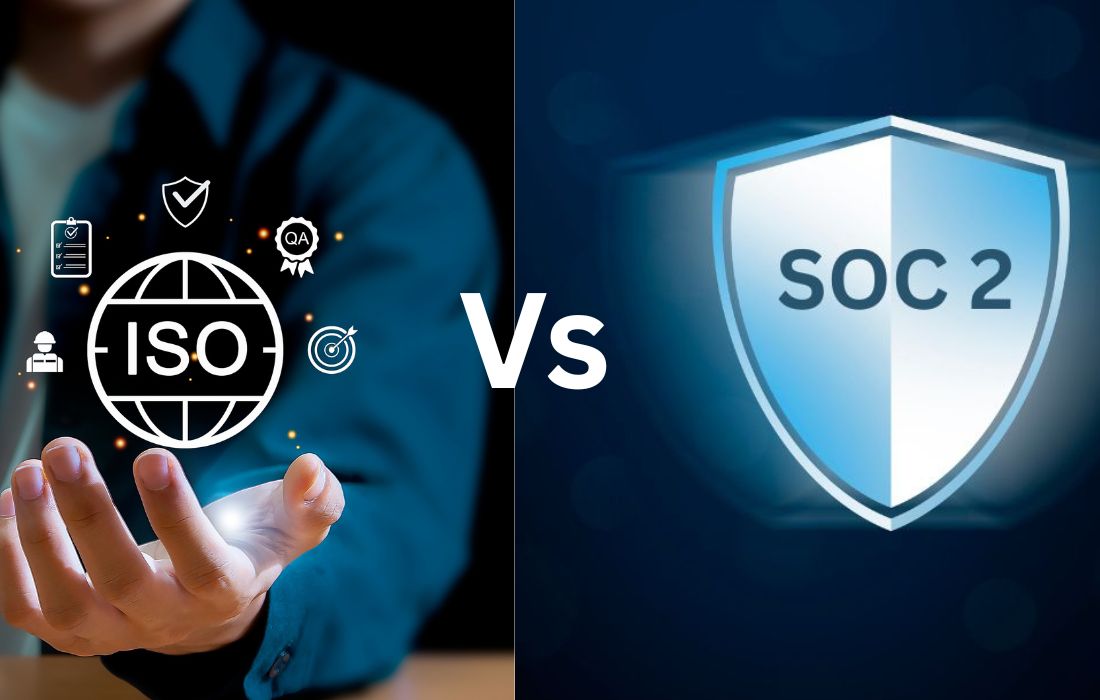
SOC 2 vs ISO 27001 is an important comparison for SaaS companies, technology providers, startups, and organizations selling to enterprise customers.
Both frameworks help organizations demonstrate that they take information security seriously, but they are not interchangeable.
The key difference is that SOC 2 is an attestation examination focused on controls against the AICPA Trust Services Criteria, while ISO/IEC 27001 is an international standard for establishing, implementing, maintaining, and continually improving an Information Security Management System (ISMS).
So, which one should your business choose?
The answer depends on your customers, target markets, security objectives, existing processes, and long-term business strategy.
SOC 2 vs ISO 27001: Quick Comparison
Factor | SOC 2 | ISO/IEC 27001 |
Primary focus | Controls and trust criteria | Information Security Management System |
Developed by | AICPA | ISO and IEC |
Result | SOC 2 examination report | ISO 27001 certification |
Commonly requested by | SaaS and technology customers | Global enterprises and organizations |
Geographic use | Especially common in the U.S. | International |
Assessment | SOC examination | Certification audit |
Yes | No equivalent Type I/II structure | |
Risk management | Included through applicable criteria and controls | Core part of the ISMS approach |
Best suited for | Demonstrating controls to customers | Establishing a formal security management system |
What Is SOC 2?
SOC 2 is an examination framework developed by the American Institute of Certified Public Accountants (AICPA).
It is designed to evaluate controls relevant to the AICPA’s Trust Services Criteria. These criteria cover areas including security, availability, processing integrity, confidentiality, and privacy.
SOC 2 is particularly common among:
- SaaS companies
- Cloud service providers
- Technology companies
- Data-processing businesses
- Managed service providers
- B2B software companies
For these organizations, SOC 2 can help demonstrate to prospective customers that appropriate controls exist around systems and data.
SOC 2 Type I vs Type II
SOC 2 reports are commonly divided into Type I and Type II.
A SOC 2 Type I examination evaluates whether controls are suitably designed and implemented at a specific point in time.
A SOC 2 Type II examination goes further by evaluating the operating effectiveness of controls over a specified period.
This makes Type II particularly useful when customers want evidence that controls are not merely documented but are operating consistently.
What Is ISO 27001?
ISO/IEC 27001 is an international standard for an Information Security Management System (ISMS).
Rather than focusing only on individual controls, ISO 27001 takes a broader, risk-based management approach to information security.
The standard specifies requirements for establishing, implementing, maintaining, and continually improving an ISMS. Organizations identify information-security risks, determine how those risks should be treated, implement appropriate controls, and continually monitor and improve the system.
An ISO 27001 program typically involves areas such as:
- Information security policies
- Risk assessment and treatment
- Asset management
- Access control
- Incident management
- Business continuity
- Supplier security
- Employee awareness and training
- Internal audits
- Management review
- Continual improvement
An organization that successfully completes the relevant certification process can demonstrate ISO/IEC 27001 certification.
SOC 2 vs ISO 27001: 7 Key Differences
1. Attestation vs Certification
One of the biggest differences is the outcome.
A SOC 2 engagement produces an attestation report from a CPA firm.
ISO 27001 can result in an ISO 27001 certificate following an audit performed by an appropriate certification body.
Therefore, businesses typically say they have a SOC 2 report or are ISO 27001 certified.
2. Controls vs ISMS
SOC 2 evaluates controls against applicable Trust Services Criteria.
ISO 27001 is built around an organization’s Information Security Management System.
This means ISO 27001 places significant emphasis on the way an organization manages information-security risks as an ongoing business process.
SOC 2 can also involve extensive security controls, but the underlying framework and assessment objectives are different.
3. U.S. Market vs International Market
SOC 2 is especially familiar among U.S. technology companies and enterprise buyers.
ISO 27001 is an international standard used across countries and industries.
That doesn’t mean SOC 2 is only relevant to U.S. businesses or ISO 27001 is only relevant outside the U.S. Both can be valuable internationally.
The practical question is:
What do your customers and prospects require?
If enterprise prospects repeatedly ask for SOC 2, that may make SOC 2 the logical first priority.
If international customers specifically require ISO 27001 certification, ISO 27001 may provide greater commercial value.
4. SOC 2 Type I and Type II vs ISO Certification
SOC 2 has Type I and Type II examinations.
Type I evaluates controls at a point in time, while Type II evaluates the operating effectiveness of controls over a period.
ISO 27001 does not have an equivalent Type I/Type II structure.
Instead, certification involves an audit of the organization’s ISMS followed by ongoing surveillance and recertification activities as applicable.
5. Risk Management
Risk management is fundamental to ISO 27001.
The standard requires organizations to establish a systematic approach for managing information-security risks.
SOC 2 also addresses security and controls, but it is structured differently and should not be treated as an alternative name for an ISMS.
For organizations looking to formalize information security as an ongoing management system, ISO 27001 can be particularly relevant.
6. Customer Assurance
SOC 2 is often used directly in enterprise vendor due diligence.
A potential customer may ask a SaaS provider for its SOC 2 report before approving the vendor.
ISO 27001 certification can similarly provide evidence of an organization’s security-management practices, particularly when procurement teams require internationally recognized certifications.
The value of either framework therefore depends heavily on what your target customers recognize and request.
7. Scope and Business Objectives
Both SOC 2 and ISO 27001 can be scoped around relevant parts of an organization, but their approaches are different.
The right scope should reflect the systems, services, information, risks, and business processes that need to be covered.
Organizations should avoid treating compliance as simply a checklist. The objective should be to build security processes that are appropriate to the business and sustainable over time.
SOC 2 vs ISO 27001: Which Is Better?
There isn’t a universal winner.
The better choice depends on your company’s customers, market, security maturity, and business goals.
Choose SOC 2 if:
SOC 2 may be a strong fit if:
- You operate a SaaS or technology company.
- Your customers are primarily U.S.-based businesses.
- Enterprise prospects frequently request SOC 2.
- Your sales process includes detailed security questionnaires.
- Customers want assurance about the controls protecting their data.
- A SOC 2 report is becoming a requirement for closing enterprise deals.
Choose ISO 27001 if:
ISO 27001 may be a better fit if:
- You sell to customers internationally.
- Enterprise buyers specifically request ISO 27001.
- You want a formal Information Security Management System.
- Your organization wants a structured risk-management process.
- International certification is important to your sales or procurement strategy.
- You want information security integrated into an ongoing management system.
Choose Both if:
Some organizations benefit from pursuing both SOC 2 and ISO 27001.
This is particularly relevant when customers across different regions have different compliance requirements.
There can be significant overlap in security policies, controls, risk management, evidence, and operational processes. However, completing one framework does not automatically mean you have completed the other.
SOC 2 vs ISO 27001 Cost
There is no standard price for SOC 2 or ISO 27001.
Total cost can vary significantly depending on:
- Organization size
- Number of employees
- Systems and applications
- Audit scope
- Number of locations
- Existing security maturity
- Compliance software
- Consultants
- Audit or certification fees
- Remediation requirements
- Ongoing monitoring
Companies should therefore evaluate total compliance cost, not simply the auditor’s or certification body’s fee.
A company with mature security policies and established evidence collection may require considerably less preparation than an organization building its security program from scratch.
Is SOC 2 or ISO 27001 Better for SaaS Companies?
For SaaS companies, the right choice usually depends on customer requirements.
If your target market consists primarily of U.S. businesses that routinely request SOC 2 reports during vendor due diligence, SOC 2 may be the most commercially useful starting point.
If your SaaS business sells internationally and enterprise customers specifically require ISO 27001 certification, ISO 27001 may be the stronger priority.
For larger SaaS companies selling across multiple markets, pursuing both may eventually make sense.
Can SOC 2 Replace ISO 27001?
No.
SOC 2 and ISO 27001 overlap in several security-related areas, but they are different frameworks with different objectives and assessment approaches.
A SOC 2 report does not automatically provide ISO 27001 certification.
Can ISO 27001 Replace SOC 2?
No.
Similarly, ISO 27001 certification does not automatically provide a SOC 2 report.
If a customer specifically requires SOC 2, an ISO 27001 certificate may not satisfy that customer’s procurement requirements.
Frequently Asked Questions
No. SOC 2 is an attestation examination focused on applicable Trust Services Criteria, while ISO/IEC 27001 is an international standard for an Information Security Management System.
Neither is universally easier. The difficulty depends on the organization’s size, scope, existing controls, documentation, risk-management processes, and security maturity.
Yes. Organizations can pursue both, particularly when customers or markets require different types of security assurance.
Startups should usually begin with customer and market requirements. If key prospects request SOC 2, it may be the better first investment. If target customers require ISO 27001 certification, that may take priority.
SOC 2 is generally described as an examination or attestation rather than an ISO-style certification. Organizations receive a SOC 2 report following the applicable examination.
No. Type I and Type II are SOC 2 examination categories. ISO 27001 uses a certification audit and ongoing surveillance and recertification process rather than the SOC 2 Type I/Type II model.
SOC 2 vs ISO 27001: Final Verdict
SOC 2 and ISO 27001 can both strengthen an organization’s security program and provide valuable assurance to customers, but they serve different purposes.
SOC 2 is primarily focused on providing assurance about relevant controls through an attestation report. ISO/IEC 27001 focuses on establishing and continually improving an Information Security Management System.
If you’re deciding between SOC 2 and ISO 27001, don’t simply ask which framework is “better.”
Instead, ask:
What do our customers require, which markets are we targeting, and what security management approach best supports our business?
For some companies, the answer will be SOC 2. For others, it will be ISO 27001. And for organizations selling to a broad international enterprise market, pursuing both may provide the strongest overall coverage.